Day 5 Cuzco, Peru: Altitude Sickness

Not for Traveling Amateurs

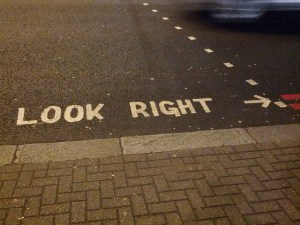
Today was a travel day for us flying from Lima to the mountainous city of Cuzco. I’m not a traveling amateur and have travelled a great deal but i must say the approach into the airport here was something else. Weaving between mountain tops in the clouds, our Airbus 320 then made a dramatic turn placing the aircraft on its side to make the final approach with the runway.

Bob and I looked at each other with a nervous smile that said lots. We were both relieved when the wheels touched down and our plane taxied the very long runway to the terminal.

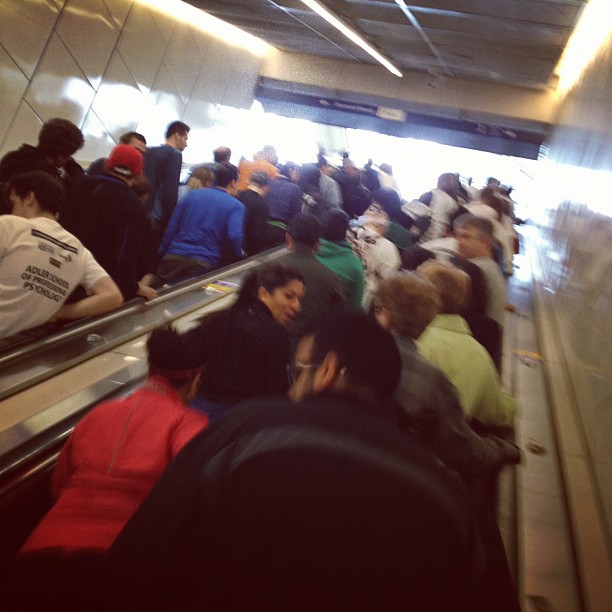
Cuzco’s elevation is 11,300 feet. Imagine six of Toronto’s CN Tower stacked on each other reaching over two miles into the sky with me sitting on the top. That is equivalent to where we are. When you walk from the plane to the terminal you immediately notice the altitude’s effect on you. It starts with a shortness of breath, a headache and a pressure in your chest like someone stuck a brick in behind your diaphragm. I was half expecting oxygen masks to drop when they opened the airplane doors.

We walked about six blocks from our hotel to get some supper and on our return we felt like we had run a marathon. At night I experienced a hard time breathing even when lying in bed. It is hard to sleep when your pulse is racing like you are at the gym. It will make for a pretty sleepless night, and we have an early morning to board a train to Machupicchu.


Athletes and Altitude
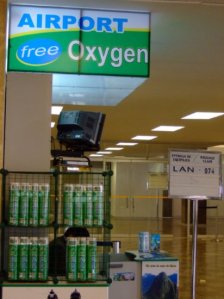
They say that it is good for athletes to train at these altitudes. We talked about how our friend David should be with us practicing his waterskiing on Lake Titicaca nearby.

What is interesting is that this altitude affects everyone. Whether you are a marathon runner or an out of shape 56-year-old, if you climb too high too fast you will experience symptoms.

This made me think of same principle in leadership. If a leader climbs the career ladder too quickly the symptoms will show. Do you know of a leader who got promoted too quickly? I’ve seen it happen to three different types of leaders.

  1. A leader who is very gifted but lacks the experience for the new position and whose ego needs do not allow them to ask for help.
  2. A poser, a leader who actually does not have the goods for a high altitude position but has bluffed their way through life so far.
  3. A good leader who gets promoted because they are so loyal. No one stops to ask if they really have the skill set and gifts necessary to handle the new promotion.

Of course there can be other types of leaders who find themselves at high altitude leadership too quickly but no matter how one gets there the symptoms begin to emerge and if the leader is self-aware they too will feel that brick behind the diaphragm.

How to Overcome Altitude Sickness

So how does one overcome this?

Well, for the leader who deep inside senses they have climbed too high too fast, find a mentor who can help you develop quickly – or better still, try to get into an Arrow Leadership class STAT.

If you find yourself two miles high on top a mountain, the local favorite treatment for actual altitude sickness is cocoa tea. It tastes like green tea, just don’t try bringing any back to North America.


Day 4 Lima Peru: No Problem

Hospitality and Excellence

Our teams at First have been hearing me emphasize two focus words for 2012 – Hospitality and Excellence.

Why? Well, we describe ourselves as a community, and that implies a relationship. To welcome people into a community requires an expression of hospitality and I think this is especially true for those living downtown. A core requirement for a community is interaction between the members and the downtown presents such diverse people groups that this can be hard. It is making me think a great deal about how we can enhance community building at First Vancouver.

Complex Communities

Pastor Samuel Reátegui and his daughter Susana met us to drive us to the ocean (Pacific) and to see more of the district of Miraflores. Samuel wanted us to see the beauty of the ocean (that we share) and a terrific view of the city. The view however was partially eclipsed by a heavy marine layer fog that often hangs over Lima during the winter months.

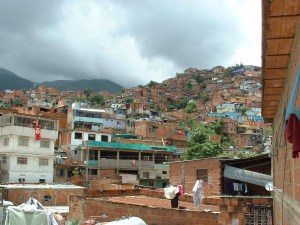
Miraflores is an upper class community of people living in multi-million dollar homes ironically bordered by barrios – housing made of metal and wood scraps strung over adobe bricks.

Interesting that they both have a million dollar view.

Real Community

Three thoughts from the day:

1. The differences between people groups that attend our church are not as readily visible as the contrast between barrios and mansions, but they still exist. How can they build community beyond their affinity groups?

2. Here in Peru, there exists a strong value on being in community. People love being together. Even among the very poor, their default is to join all of their belongings together. They may all be poor, but perhaps together something good will come of it if they face it together.

In our culture downtown, when people are going through tough times the tendency is to hide and make it through yourself. How can we make it easier for people to join into community during tough times and good times.

3. My final insight came through the example of Samuel, Margarita and their two daughters. We were strangers with the exception of a few email interactions prior to our trip to Lima. We left as family. The value of hospitality is such that they seemed to drop everything to welcome us, translate for us, transport us. Throughout the day we heard him enthusiastically express in one of his favourite English expressions, “No problem.”

Part of this instant community is being in the family of God, but beyond this there is a value where Bob and I were meant to feel as treasured guests, and they did this with excellence.

I’d love the chance to honour them with a return of hospitality in our city someday.

All to often in our busy downtown world we try to fit in guests around our already busy schedule. Is hospitality a spiritual discipline we need to practice more in our lives?

Day 3 Lima, Peru: “The Other Side of the Tracks”

In North America you hear the expression “the other side of the tracks” referring to a part of the city that is considered poor and dangerous. As in, most fathers would not want their daughter going out with a boy from the “other side of the tracks.”

Well here in Lima the expression is “the other side of the river” and it has the same meaning.

We began our third day meeting Pastor Samuel Reátegui and his daughter Susana, who drove us to the other side of the river, and provided a different view of the city. The central parts of the city, and the districts of Miraflores and San Isidro, are as modern as any city in the world. Yet, on the outskirts of Lima, the terrible slums remind one that Peru still has a long way to go.

Now from what I saw today I have to say that I have seen worse, but I also know that our pastor friend was not showing us the worst that Lima has to offer. He carefully warned us of dangerous areas and told me when to pull my camera back in as we passed some sketchy looking youth.

Bob commented to the pastor on the lack of beggars in the streets, to which he replied that the beggars are all found in the rich districts of the city. Ironic yes, but makes sense.

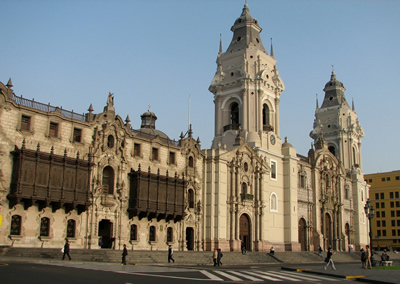
Sitting on the right side of the river is the Plaza de Armas, a spectacular colonial square with a fountain n the center surrounded on four sides with the Presidential Palace, The Archbishop Palace ( a seemingly new structure by a few hundred years), the Lima Cathedral (a strong statement about the history and influence of the Roman Catholic church in this part of the world), and the CIty Hall as well as a few other building not described to me. This old colonial center in Lima is a World Heritage site and was the crown jewel of Spain’s South American empire.

It is the economic contrasts that is so challenging here in Lima. The majority of Peruvians live in poverty – 54% according to the CIA World Factbook. It is estimated that 19% live in absolute poverty surviving on less than a dollar a day CDN. Sobering. In several conversations with leaders here the work of World Vision has come up as one organization that has really helped to transform communities or districts. This did not surprise me after experiencing their work in Bolivia, Peru’s neighbor to the east.

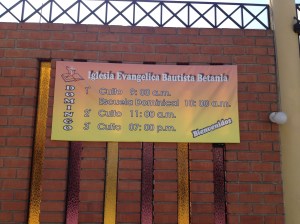
At noon hour we went back to Bethany Baptist Church where pastor Samuel had invited other ministers to come meet me. We enjoyed a lovely time talking over lunch about the work they are doing in this complex city. I was able to video tape several of them sending messages back to those working in the cities of North America.

Two insights from today: 1. These pastors were all happy folks despite working in more challenging circumstances than almost every pastor I can imagine in Canada or the US. 2. They are just busy being the church in the heart of the city and by that I mean helping others, discipling believers and bringing truth and justice to bear for the sake of their communities. It is not flashy – just effective.

Day 2 Lima Peru: We Don’t Honk Enough

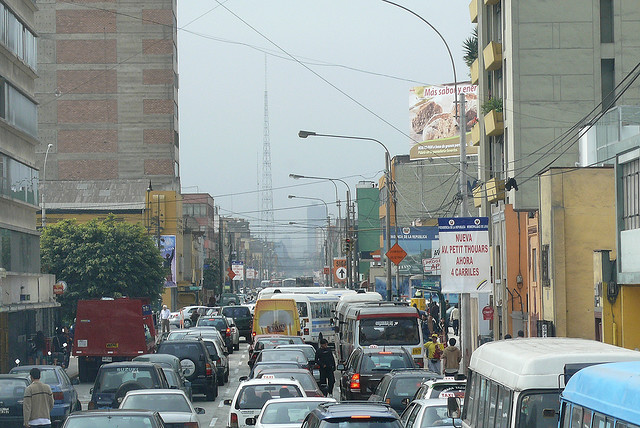
After over eleven hours in the air we were delighted to finally get to our hotel in Lima with the prospect of getting a real sleep. That was at 2:30am, so imagine my pleasure of being wakened by the sounds of hundreds of cars honking to one another.

They did awaken me, but amidst the roosters crowing and general traffic sounds, both Bob and I noticed how their honking is different from ours. We usually honk when we are angry. Here in Peru they honk just to say, “Heh, I’m here,” or “Hello”.

Peru is a country that is one tenth the size of Canada geographically however with almost the same population base. It is bordered by Ecuador and Columbia to the north, Brazil and Bolivia to the east, and Chile to the south.

Although Peru has rich natural resources and a booming economy almost 40% of the population live below the poverty line. Now, I have seen visible poverty before and what I always find difficult is in countries where there is such visible disparity between the rich and the poor. I am sure it is a complex economy here and I look forward to finding out more. Our hotel is surrounded by this very disparity – not that we are in a fancy hotel (more on that later) but the living conditions not far from here.

Yet the Latino people are friendly and helpful. Our background in French and Latin still comes in helpful in trying to communicate.

Tonight we are visiting and interviewing the pastor of Iglesia Bautista Betania a downtown church in the Lince district of Lima. Bethany Baptist Church as we would call it is connected to Christ for the City International.

The pastor called our hotel and Bob took the call. Bob commented, “He was very enthusiastic!” Much like their honking I assume.

How many people downtown are self aware?

I find myself people watching each day I walk downtown. I watch as they talk and interact, or walk in isolation seldom looking up from the sidewalk. I watch them walk by in their thousand dollar suits or the clothes they slept outside in overnight. No matter their status, I wonder how aware they are – of who they are?

All leaders have an understanding of how knowing your personality, both strengths and weaknesses, can help you become a better leader.

With improved awareness we begin to recognize where that strength of ours can become a weakness. We develop more perspective and are able to have more understanding of different sides of ourselves and others.

By knowing more about our own personality qualities we are able develop and strengthen the ones we want to or need to work on. This gives us a greater ability to work with others and see the strengths and needs of the people around us.

Leaders who become more and more self-aware feel more balanced, more integrated and whole. Now for those of us who are followers of Jesus the beginning of awareness is in knowing who we are as a child of God.

Mentoring certainly helps a leader increase self acceptance by helping them to accept more of their strengths and weaknesses. It can help us recognize where we still need to experience freedom so that we can pursue the vision God has for us.

What might group mentoring look like in the downtown and who would be interested – he ponders?

Love downtown – Carson

Around the World In Seventy Six Days

Into the Global South

ImageOn May 1, 2012 I am embarking on a journey around the world in the global south. I am travelling with my long time friend Bob Kuhn. Our friendship, together with David Bentall, is featured in the book The Company You Keep and those who have read this may not be surprised that two men in their fifties are even thinking about an itinerary like this.

Not for sightseeing

We have two objectives, well maybe three. The first is a desire to meet Christian leaders in the global south, listen to them and ask them to speak to us as leaders in the north. There is no question that followers of Jesus are experiencing a movement today in the southern hemisphere that those in the north long for. God is far from dead in the global south.

Pastors, ministry leaders and Christians serving with government or in the marketplace will be interviewed and we will tell their stories. We will find them in the center of some of the world’s largest cities and in remote villages where people struggle to live daily due to the effects of complexity of poverty. As well as writing a new book about our adventure I will be sending short video reports to MyVu that will be featured by Crossroads Communication across Canada and available online. The congregation at First Baptist Vancouver will be following me around the globe through video messages I will be sending back for each of the Sundays I am away.

Our second objective is related to Bob.  He was diagnosed with Parkinson’s disease over six years ago.serving as an ambassador for World Parkinson Congress 2013 to be held in Montréal.  This world-renowned event drawing 3 – 4000 of the best researchers, clinicians and leadership in the Parkinson’s community from around the world. We will be meeting with leaders of this specific community, inviting them to come to Canada to participate in WPC 2013. Bob is a blogger and will be sharing our journey on Positively Parkinson’s along the way.

Image

The third objective is to deepen our friendship together and have fun being surprised by the works of God through the people we meet.

Not for the faint of heart: Our itinerary

What would you ask?

If I could take you with me, what questions would you ask of leaders in the global south?

What would you like me to find out on this journalistic journey?

USA and Canada: get ready!

Right to practice the Christian faith under attack in Britain

I happened to be in London last week on the day two major court rulings were made against people worshiping Jesus in Britain.

For several years I have made an observation. Whatever the ‘trend’ in Christianity such as the profound influence of postmodernism or the influence of the new atheism – the UK is usually five years ahead of the same trend being evident in Canada. The USA then trends five years after Canada’s experience. So as you read the following think about getting ready because this kind of challenge is heading to a town or city near you… and nothing seems able to stop it.

The right to practice the Christian faith is under attack in Britain as evidenced in two controversial legal rulings.

A High Court judge in London ruled that the custom of saying prayers at council meetings – a custom that started by Queen Elisabeth – the first one.

Atheist and former councilor Clive Bone claimed he was both disadvantaged and embarrassed when prayers were said at formal meetings of the Council when he started the case.

Where is this headed? The ruling will probably pave the way for the ending of prayers at the opening of Parliament, in the House of Commons or Lords. Well it could be the end of hospital and military chaplains. What about the coronation of the next king in Britain? Isn’t there a prayer said at that time?

Bed and Breakfast/ business rights?

The second case was one of the Appeal Court ruling that two Christian Bed and Breakfast owners broke the law by refusing to allow a gay couple to stay together in a double room. The court told the owners that they were entitled to express their beliefs, but not if they were incompatible with the rights of gay people.

Even though the Bed and Breakfast had also barred unmarried heterosexual couples from sharing double rooms for the past twenty-five years. This ruling confirms the supremacy of gay rights over Christian belief under the Sexual Orientation Regulations introduced by the Labor Party

Christians are suffering intolerance as Jesus followers are being pushed into the background by secularism. Lord George Cary (former Archbishop of Canterbury) stated Britain is “enslaved to multiculturalism, political correctness and so-called equal rights.”[i] Lord Carey has been urging the British Prime Minister to act in a manner to safeguard the founding Christian traditions in England.

Jewelry rights?

I flew back to London from Uganda on British Airways. You know, the airline that sent home a flight attendant for failing to take off or conceal a cross necklace she was wearing. Seriously? A cross? That most ancient and comforting symbol of Christianity in the form of nice jewelry is liable to offend so she should be sent home from work? We see many pop stars wearing a cross without claiming any affiliation with Christianity.

There is probably a five to ten-year window in which religious freedom issues are going to press in on Christians in North America. It is time for church leaders to start conversations with their politicians. It is time that current church leaders show some courage. It is time our politicians start defending the rights of Christians and not consider them to be less important than those of every other sector of society.


[i] Daily Mail, February 11, 2012

The Last Shepherd

Preschool Christmas Pageant

There were 13 of us present in the room of perhaps 50 adults. We jostled for the ‘adult seats’ among the preschool sized versions and waited expectantly.

When the door opened, I strained my eyes to identify my four-year-old grandson Landon. Joseph led the way followed by Mary carefully carrying the doll. Many, many, angels followed but Landon was not among them.

The Wise men, maybe I’ll see him there? Nope. They all came and sat in their places identified by masking tape on the floor. There was noise in the back hallway of teachers whispering and little voices and then the shepherds came. Still anxiously awaiting the sight of my grandson my heart quickened as I recognize the eyes… and then his lips – partially hidden behind the headwear made out of drapery fabric.

Landon was the last shepherd.

The short Christmas pageant at the preschool was absolutely delightful. Children anxiously waiting the time to say “their line” At that point or nod of their teacher.

The Last Shepherd - Landon

I turned to Martha, a grandmother in waiting, and proudly pointed out that my grandson was the last shepherd. It was when I uttered the words “last shepherd” my mind began to wonder who in the Christmas story was the last shepherd? Who was the last one to get it and realize that the Messiah had been born.

Who was the last shepherd in the gospel story to actually clue in to the fact that an angel stood among them?

The Air Show

Landon and I went to the air show this past summer. I was amazed with how he was able to pick out the small dots in the sky and identify quickly when a plane was coming. Certainly he would not have been the last shepherd. He would’ve seen that angel coming a mile away.

But some shepherd had to be the last. Maybe he was bent over tying his sandal, or doing his last round protectively circling the herd.

The ancient text reads:

And there were shepherds in that very region bivouacking in the fields under the open sky, and guarding their flock during the appointed night watches. And an angel of the Lord took his stand at their side, and the glory of the Lord shone round about them, and they feared a great fear. And the angel said to them, “stop being afraid. For behold, I am bringing you good tidings of great joy, which joy is of such a nature that it shall pertain to all people because there was boring to you today a savior who is Christ, the Lord, in the city of David. And this shall be an unusual and distinguishing token of identification for you; you shall find a newborn infant which has been wrapped in cloth bands, and is lying in a feeding trough.” And suddenly there was with the angel a multitude of the army of Heaven, praising God and saying, “glory in the highest places to God, and upon earth peace among men of goodwill.”

Now that was a message we would not want to miss out on. On that evening I’m sure the glory around this angelic interruption would have captured all of the shepherds’ attention. But for you and I today, we need to be alert to all the ways that God may appear to us for it is so easy to grow spiritually blind or deaf.  Often we can have no sense of expectancy, and hear nothing from the Lord. If we come into the day of alert and expecting God to speak to us, he will do just that.

I am positive that if we are alert this Christmas season we will hear God’s voice speaking to us through carols, a sermon, that friend of yours, or perhaps a book or radio broadcast.

So this Christmas let’s listen to everything God wants to say to us – no matter where you are in the lineup, first, second or last.

Merry Christmas,

Carson Pue

When a Leader is Falsely Accused

Have you ever had the experience of someone deliberately attacking your character and trying to ruin your reputation by unjustly accusing you?

Dave Toycen, president of World Vision Canada, has been plagued by a malicious and erroneous email that has ‘gone viral’ stating he is overpaid, drives an expensive car, and lives in an extravagant house.

I am close to Dave and respect him deeply as a leader. With grace and skill, he leads a complex organization that everyday is making a difference in the lives of vulnerable children, families and villages around the world. We travel together; hang out together – why I have even seen him get into his car!

For the past seven years I have served on the board of directors for World Vision Canada and as such am one of those responsible for setting Dave’s salary and benefits. In a spirit of authenticity and transparency our board has been posting his salary on the website for years along with our policy on executive compensation.

http://www.worldvision.ca/About-Us/financial-information/Pages/our-approach-to-executive-compensation.aspx

These false accusations quickly circle the globe on the world-wide web and land in the inbox of people who may be monthly supporters of World Vision’s work with children. The result? Some supporters call the World Vision Office and express deep concern. This uses valuable staff time as they respond. Others withdraw their support without even checking to see that the email is identified as an “urban myth” as the public site www.snopes.com clarifies.

The ripple effect of this attack on one leader is that boys or girls suffer. They are the ones ultimately impacted by an erroneous email filled with misinformation. Children, who every day are simply trying to survive due to the effects of poverty, are hurt by someone trying to find fault, blaming and condemning.

So what can you do?

If we receive emails making claims that are harsh and judgmental we must not circulate them without verifying facts. The internet becomes a contagion for spreading lies. Remember people at the other end of that email are impacted by this – in this World Vision case, poor innocent children.

But what if you are the one who is being falsely accused? Most Christian leaders I know or mentor experience the challenge of a false accusation at some point in their life of leadership.

False accusations and unjustified attacks eat leaders up from the inside. Afflicting you, discouraging you, and distracting you from the people or mission to whom God has called you; a lie is intended to destroy you. It is a natural response to want to strike back, to fight the lies, and stop the attack. However, in my experience, this is very difficult to do and seldom accomplishes what we desire. I mentor leaders to not perpetuate a feud that could go on for years but rather ‘let it go’.

What God desires is that we leave it with Him. If someone is attacking a Christian leader then God is also being attacked and He teaches: “Dear friends, never take revenge. Leave that to the righteous anger of God. For the Scriptures say, “I will take revenge; I will pay them back,” says the LORD. (Romans 12:19 NLT).

God can defend His own name and in doing so vindicate those falsely accused. Our problem is often waiting for God to act.

So let’s not stand for any more false accusations. Pick up the phone and check it out before you are tempted to forward a malicious email.

What saddens me the most is that I strongly suspect the source for the email I have been referencing was one who would claim to be a Christ follower.

Romans 14:10 in the Amplified Bible reads, “Why do you criticize and pass judgment on your brother or sister? Or you, why do you look down upon or despise your brother or sister? For we shall all stand before the judgment seat of God”.

It continues in verses 12-13:  (12) “And so each of us shall give an account of himself – give an answer in reference to judgment – to God.”  (13) “Then let us no more criticize and blame and pass judgment on one another, but rather decide and endeavor never to put a stumbling block or an obstacle or a hindrance in the way of a brother or sister.”