Day 9 Santiago, Chile: Public Transit to the Palace

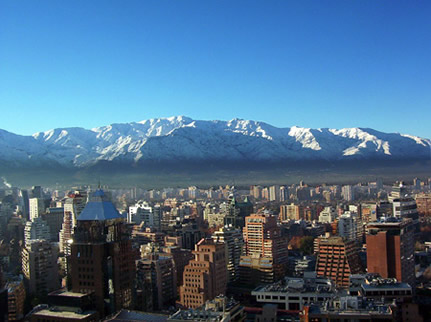
Flying into Santiago the city is completely surrounded by mountains, like it is in a meadow amidst snow-capped peaks. The ocean lies to the west and is accessible through a valley pass while the majestic Andes to the east.

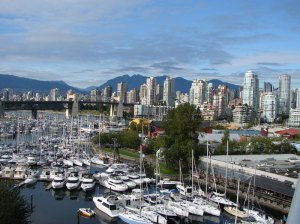
It is already reminding me a lot of Vancouver and there is a common expression here in Santiago like we have at home saying that you can ski in the morning and sail in the afternoon.

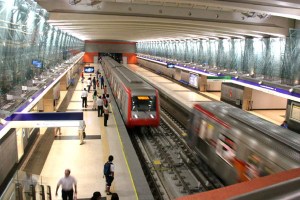
An organized city of 6.25 million it seems quite manageable both in size and because of  the subway system – the Metro.

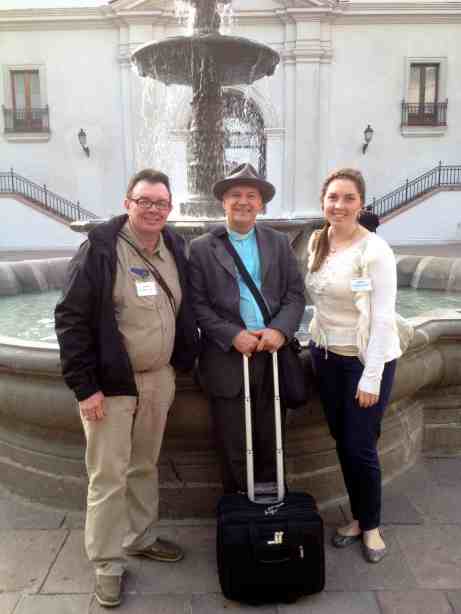
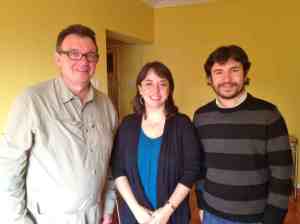
James Matheson, a gifted younger leader, served as our host while here. He conscripted dad to meet us at the airport and take us to our hotel the night we arrived. The next morning James met me at the hotel and we walked to the subway to begin a day of interviews.

James is a communication major at university and works with YFC here in Santiago. He is a very networked guy and seems to know everyone. On the way to the subway we stopped and picked up Justine, daughter of a Baptist pastor from Dartmouth, NS who is in Santiago for the term and off we went, two Canadians and a Chilean. Bob stayed and rested today at the hotel.

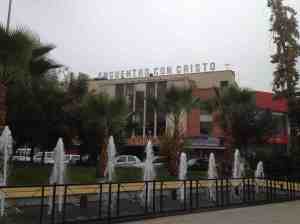
Encuentro Con Christo

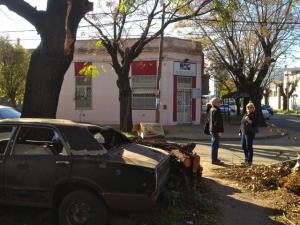
We travelled by underground to “Encuentro Con Christo” (Meeting with God). This church in a great location in Santiago with a large shopping mall under construction across the street and very close to the Metro.

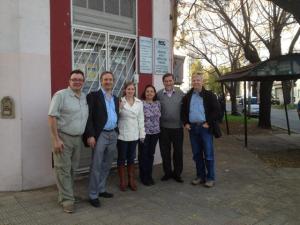
The first person to greet me when I entered was Marlene – a close friend of my colleague Luz back at FBC and I was welcomed like family. They had set up a meeting room for me and I conducted interviews there in the morning.
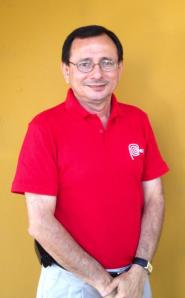
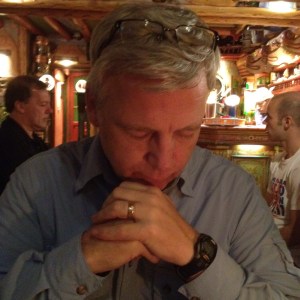
Pastor Jorge Eduro is the teaching pastor at the church and has been here thirty years and what brings him greatest joy is building the team among the pastors.

Miner’s Home Place

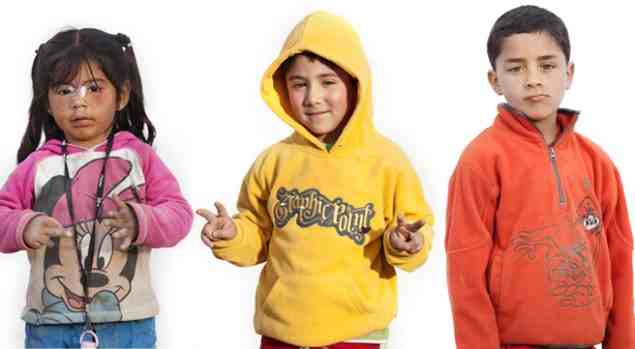
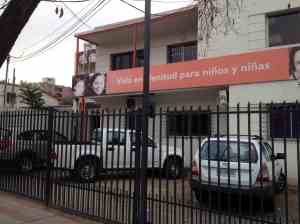
Luis Castro is a leader of a home for miners children. He left a secure job and salary to work full-time helping vulnerable youth. They have on home with forty-five boys and girls and a waiting list of thirty.

World Vision Chile

Elza Fagundes is the national director of World Vision Chile where she and her team oversee over 35,000 sponsored children and then the many more family members who also benefit through their sponsorship program.

We met in their offices with other senior staff including a pastor responsible for church relations. I have visited staff of World Vision in over a dozen countries around the world and I am consistently impressed with the caliber of people working to save and protect children.

Next to Group Biblica de Universitad, the IFES group working in over thirty-five campuses of university and colleges. Their commitment to students is impressive and to hear that they are only able to touch half the campuses in this city is a little daunting.
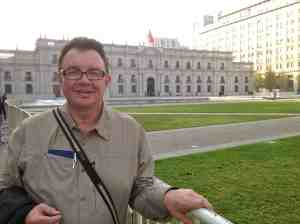
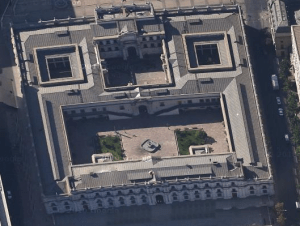
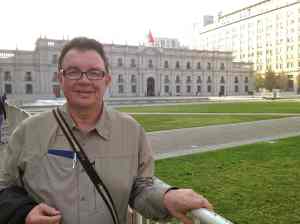
The surprise addition to the day was a late invitation to come to the presidential palace. Alfred Cooper, Capellán Evangélico en La Moneda is the chaplain and spiritual advisor to the president and was a significant leader during the Chilean mine disaster. He called James and wanted us to meet.

More on this tomorrow.

Day 8: Quite the stressful adventure

Day 8 was a long travel day first with a flight from Cusco to Lima then on to Santiago, so a rather boring blog day. We did think it was exciting that we knew where to go at the Lima airport to get free wi-fi from our previous flight through Lima, so there was time for a quick call to our wives en route.

Enough of this,  let’s go back to yesterday.

Watch Your Pockets

Two teenagers at Machu Picchu approached me when I had my iPhone out taking pictures. They asked politely if I would take a picture of the two of them with their camera. Being the kind Canadian I am I said of course, and took a great photo of them. The guys then came on each side of me to look at the photo, commented on how good it looked and asked if I would take another which I did. They thanked me and walked off.

Well twenty minutes later I reached for my iPhone and it was gone.

Bob and I were separated at this time for he was attempting to climb Machu Picchu mountain. I was without my wingman.

I hadn’t moved from where we separated and I quickly put together what had happened. I sought out a park officer and told him my story. His English was better than my Spanish but he did understand “iPhone” and “pick pocket.” He quickly radioed all the officers to be on the lookout.

There is only one exit out of the park so he sent me to the administration office at the park gate and to fill out a form there and then stay by the gate to see if the two young guys appeared.

The women at the administration office felt badly but did not offer me much hope. They gave me a book that I was to write the loss in – I didn’t like how thick the book was. As I am writing out all my information I was praying asking the Lord to resolve this as I knew we could not possibly afford this right now and it would hinder our communication ability. I was also pre-grieving the loss of some recorded interviews I had not backed up.

As I am halfway through the form one of the administrators called to me, “Are you Dr. Pue?”

“Yes,” I said with some surprise because I had not given her my name yet.

“Congratulations, your phone has been found. Cecelia, one of the tour guides has it and will bring it here for you but she is about an hour away.” (My new business card from the church was in the phone cover.)

“Praise God,” I said as we all celebrated together.

I asked her to show me where it was found and she pointed out on a map that it was in the grass about 1000 meters from where I was.

Why would they discard it?

Just two days before this incident I had figured out how to put a coded lock on my phone. I had noticed all my sons had this and I originally thought it awkward that they had to type in this code before doing anything on the phone. However without the code the holders of my phone were hooped so probably discarded it after trying several times to guess the code.

More importantly, I have a dear group of people praying for me at First every Wednesday evening along with many others that I know of.

Inca Golden Rulers

You cannot think about the Incan’s without thinking of gold – they were golden rulers with the precious metal.

The last sermon I heard Darrell Johnson preach at First Baptist Vancouver was on “Golden Rulers” and it was a great exposition on how Jesus taught very differently from other religious expressions of reciprocity.

My Golden Ruler: Cecelia

Well  I was thinking of this when Cecelia came into the office. She spoke no English but in translation through the administrator I thanked her.

She then replied with a big smile, “Do unto others as you would have them do unto you.”

We hugged and I went off to try to find Bob – his story is amazing but that is his to tell and you can read about here on Positively Parkinson’s.

Day 7 Machu Picchu: An Ancient City

The alarm went off at 4am and it was pitch black with a full moon illuminating the town of Aquas Caliente. We packed, showered and surprised the hotel staff by coming downstairs before five.

Why? Well Bob thought it would be fantastic for us to be at the top of the mountain at the Inca ruins of Machu Picchu to see the sunrise. I was all in for that. The photos we took will allow us to remember this day forever.

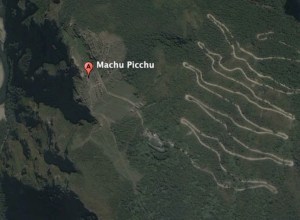
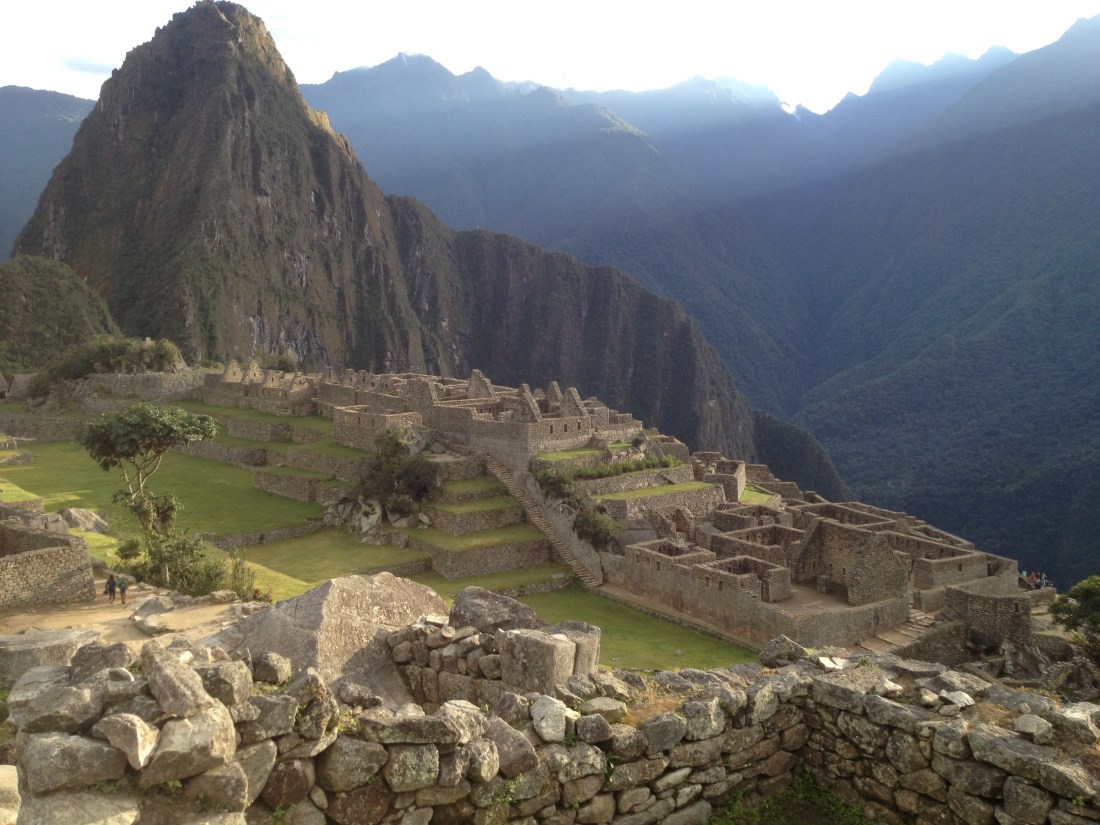
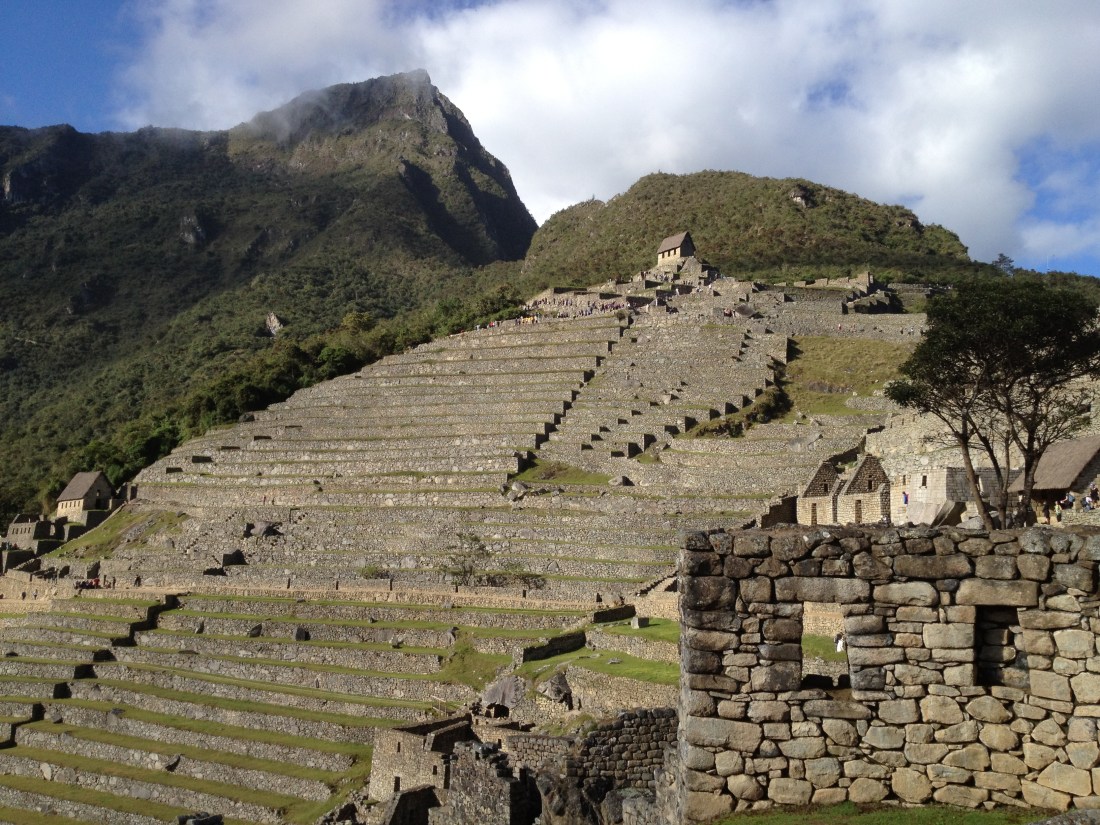
The bus ride up in the dark over the switchbacks was probably terrifying at points but we used the 30 minutes to nap. By the time we arrived at the entrance it was beginning to lighten up allowing us to get in position and watch the sunrise and particularly on the Temple Del Sol. As I looked over this ancient city located on a mountaintop in the midst of a tropical jungle I was filled with thoughts about the intricate construction how they did this and why?

A highly sophisticated structure at the same time very mysterious because of how little is actually known.

History

The facts behind Machu Picchu are not forthcoming because of the lack of any written language records. We do know this…

When the Spanish came to the shores of Peru in the fifteenth century, the Incans welcomed them openly and thought they were fair-skinned Gods. They gave the Spaniards gold of which they had plenty and were excellent craftsmen with. The Spanish explores took their treasure back to Europe and then returned for more, this time with an army. The kidnapped the Incan King and held him for ransom. The tribe brought them more and more gold and even when their boats were filled, they Spaniards killed the Incan king anyway and left behind their diseases and the start of years of occupation that led to the end of an empire.

There are four distinct sectors of the city.

Cities Old and New

I love cities and I was quite caught up by this ancient urban marvel. Covering 32,500 ha. It was the last stand for the Inca Empire and as such is recognized as a World Heritage Site. You can see four distinct parts of the city: agriculture, religious, royal and the work section of this ancient planned city. I noticed that there was no entertainment section, something my city has plenty of – perhaps that replaces the religious sector.

This made me think of the ‘parish’ around our church and the various sections of the downtown. I am so pleased that we are a church located right in the heart of downtown.

Grocery stores, community gardens and rooftop terraces replace agriculture in our downtown. Religious expressions are not readily visible although there are many new church plants happening in the downtown core of Vancouver it would not approach a quarter of our cities design.  The Royal part of downtown is perhaps our courthouse and city hall. The industry section is just down the street from us where men and women labor to earn enough to live in our beautiful city.

Insight: Machu Picchu was designed to encourage community while there are few places in our downtown that foster communities.  I am so encouraged by our emphasis on building community but this must extend beyond our walls and into the lives of those in our city. I also envision designing more community spaces in our new development in the future.

Day Six Aquas Caliente: Trains in the Andes

Our hotel arranged for a cab to drive us the thirty minutes to the train station up the mountain from Cuzco. Yes that is right. We drove uphill from the hotel until I thought my ears were going to pop. It reminded me of being in Bolivia with Brenda last summer and leaving in the morning from Cochabamba to visit villages in the mountains where World Vision is working. Bolivia is very close to where we are today, sharing the mountain range with Peru. It is amazing to see how people have adjusted to living at these kinds of altitudes.
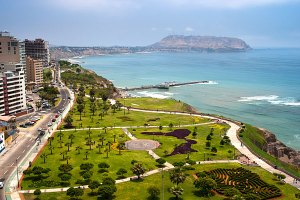
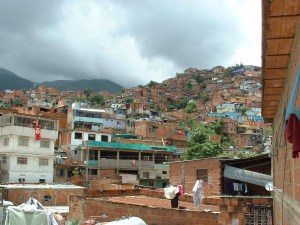
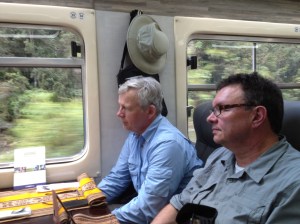
The Andean countryside is perhaps best be viewed by rail – seems true of most countries where this is an option. Our journey on Perurail was only 56 km however it would take us more than four hours.

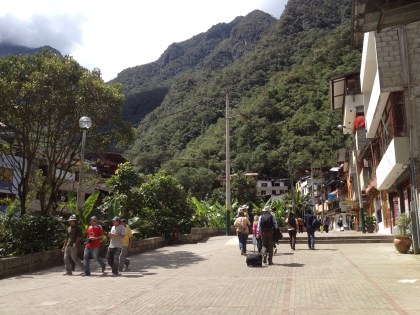
Arriving at our destination of Aquas Caliente it would become our base camp for the visit to MachuPicchu tomorrow. When you get off the train you are guided through dozens of tourist stalls selling mostly all he same things. They have certainly caught on to the dollars that can be made in tourism. We were met by an escort assigned by the hotel to walk us there through the gauntlet of restaurant owners trying to convince the two new gringos in town to eat at their place.

With the population swelled by backpackers and people from every nation, Aquas Caliente began to remind us of familiar mountain towns like Whistler or Banff in an Andean kind of way.

We had time in the afternoon for a nap and then to scout where we might go for supper that night. We found a funky fusion foodie place that even provided wifi although our attempts to connect with wives fell flat. It had nautical decor, more of a pirate kind than a yacht club – still funny to find in the mountains.

Over supper we discussed just how blessed we have already been this week. The people we have met and the sights we are seeing. I have also been blessed by emails from my family (both natural and church) telling me of their prayers and how I’m missed. They are enjoying following the trip virtually.

An insight from today, life friends are the best. 

Day 5 Cuzco, Peru: Altitude Sickness

Not for Traveling Amateurs

Today was a travel day for us flying from Lima to the mountainous city of Cuzco. I’m not a traveling amateur and have travelled a great deal but i must say the approach into the airport here was something else. Weaving between mountain tops in the clouds, our Airbus 320 then made a dramatic turn placing the aircraft on its side to make the final approach with the runway.

Bob and I looked at each other with a nervous smile that said lots. We were both relieved when the wheels touched down and our plane taxied the very long runway to the terminal.

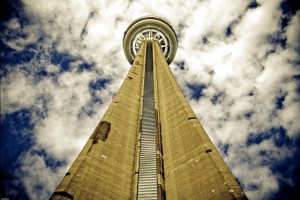
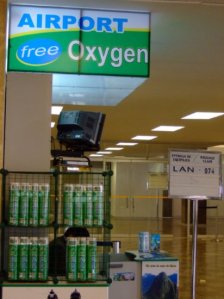
Cuzco’s elevation is 11,300 feet. Imagine six of Toronto’s CN Tower stacked on each other reaching over two miles into the sky with me sitting on the top. That is equivalent to where we are. When you walk from the plane to the terminal you immediately notice the altitude’s effect on you. It starts with a shortness of breath, a headache and a pressure in your chest like someone stuck a brick in behind your diaphragm. I was half expecting oxygen masks to drop when they opened the airplane doors.

We walked about six blocks from our hotel to get some supper and on our return we felt like we had run a marathon. At night I experienced a hard time breathing even when lying in bed. It is hard to sleep when your pulse is racing like you are at the gym. It will make for a pretty sleepless night, and we have an early morning to board a train to Machupicchu.


Athletes and Altitude

They say that it is good for athletes to train at these altitudes. We talked about how our friend David should be with us practicing his waterskiing on Lake Titicaca nearby.

What is interesting is that this altitude affects everyone. Whether you are a marathon runner or an out of shape 56-year-old, if you climb too high too fast you will experience symptoms.

This made me think of same principle in leadership. If a leader climbs the career ladder too quickly the symptoms will show. Do you know of a leader who got promoted too quickly? I’ve seen it happen to three different types of leaders.

  1. A leader who is very gifted but lacks the experience for the new position and whose ego needs do not allow them to ask for help.
  2. A poser, a leader who actually does not have the goods for a high altitude position but has bluffed their way through life so far.
  3. A good leader who gets promoted because they are so loyal. No one stops to ask if they really have the skill set and gifts necessary to handle the new promotion.

Of course there can be other types of leaders who find themselves at high altitude leadership too quickly but no matter how one gets there the symptoms begin to emerge and if the leader is self-aware they too will feel that brick behind the diaphragm.

How to Overcome Altitude Sickness

So how does one overcome this?

Well, for the leader who deep inside senses they have climbed too high too fast, find a mentor who can help you develop quickly – or better still, try to get into an Arrow Leadership class STAT.

If you find yourself two miles high on top a mountain, the local favorite treatment for actual altitude sickness is cocoa tea. It tastes like green tea, just don’t try bringing any back to North America.

Day 4 Lima Peru: No Problem

Hospitality and Excellence

Our teams at First have been hearing me emphasize two focus words for 2012 – Hospitality and Excellence.

Why? Well, we describe ourselves as a community, and that implies a relationship. To welcome people into a community requires an expression of hospitality and I think this is especially true for those living downtown. A core requirement for a community is interaction between the members and the downtown presents such diverse people groups that this can be hard. It is making me think a great deal about how we can enhance community building at First Vancouver.

Complex Communities

Pastor Samuel Reátegui and his daughter Susana met us to drive us to the ocean (Pacific) and to see more of the district of Miraflores. Samuel wanted us to see the beauty of the ocean (that we share) and a terrific view of the city. The view however was partially eclipsed by a heavy marine layer fog that often hangs over Lima during the winter months.

Miraflores is an upper class community of people living in multi-million dollar homes ironically bordered by barrios – housing made of metal and wood scraps strung over adobe bricks.

Interesting that they both have a million dollar view.

Real Community

Three thoughts from the day:

1. The differences between people groups that attend our church are not as readily visible as the contrast between barrios and mansions, but they still exist. How can they build community beyond their affinity groups?

2. Here in Peru, there exists a strong value on being in community. People love being together. Even among the very poor, their default is to join all of their belongings together. They may all be poor, but perhaps together something good will come of it if they face it together.

In our culture downtown, when people are going through tough times the tendency is to hide and make it through yourself. How can we make it easier for people to join into community during tough times and good times.

3. My final insight came through the example of Samuel, Margarita and their two daughters. We were strangers with the exception of a few email interactions prior to our trip to Lima. We left as family. The value of hospitality is such that they seemed to drop everything to welcome us, translate for us, transport us. Throughout the day we heard him enthusiastically express in one of his favourite English expressions, “No problem.”

Part of this instant community is being in the family of God, but beyond this there is a value where Bob and I were meant to feel as treasured guests, and they did this with excellence.

I’d love the chance to honour them with a return of hospitality in our city someday.

All to often in our busy downtown world we try to fit in guests around our already busy schedule. Is hospitality a spiritual discipline we need to practice more in our lives?

Day 3 Lima, Peru: “The Other Side of the Tracks”

In North America you hear the expression “the other side of the tracks” referring to a part of the city that is considered poor and dangerous. As in, most fathers would not want their daughter going out with a boy from the “other side of the tracks.”

Well here in Lima the expression is “the other side of the river” and it has the same meaning.

We began our third day meeting Pastor Samuel Reátegui and his daughter Susana, who drove us to the other side of the river, and provided a different view of the city. The central parts of the city, and the districts of Miraflores and San Isidro, are as modern as any city in the world. Yet, on the outskirts of Lima, the terrible slums remind one that Peru still has a long way to go.

Now from what I saw today I have to say that I have seen worse, but I also know that our pastor friend was not showing us the worst that Lima has to offer. He carefully warned us of dangerous areas and told me when to pull my camera back in as we passed some sketchy looking youth.

Bob commented to the pastor on the lack of beggars in the streets, to which he replied that the beggars are all found in the rich districts of the city. Ironic yes, but makes sense.

Sitting on the right side of the river is the Plaza de Armas, a spectacular colonial square with a fountain n the center surrounded on four sides with the Presidential Palace, The Archbishop Palace ( a seemingly new structure by a few hundred years), the Lima Cathedral (a strong statement about the history and influence of the Roman Catholic church in this part of the world), and the CIty Hall as well as a few other building not described to me. This old colonial center in Lima is a World Heritage site and was the crown jewel of Spain’s South American empire.

It is the economic contrasts that is so challenging here in Lima. The majority of Peruvians live in poverty – 54% according to the CIA World Factbook. It is estimated that 19% live in absolute poverty surviving on less than a dollar a day CDN. Sobering. In several conversations with leaders here the work of World Vision has come up as one organization that has really helped to transform communities or districts. This did not surprise me after experiencing their work in Bolivia, Peru’s neighbor to the east.

At noon hour we went back to Bethany Baptist Church where pastor Samuel had invited other ministers to come meet me. We enjoyed a lovely time talking over lunch about the work they are doing in this complex city. I was able to video tape several of them sending messages back to those working in the cities of North America.

Two insights from today: 1. These pastors were all happy folks despite working in more challenging circumstances than almost every pastor I can imagine in Canada or the US. 2. They are just busy being the church in the heart of the city and by that I mean helping others, discipling believers and bringing truth and justice to bear for the sake of their communities. It is not flashy – just effective.

Day 2 Lima Peru: We Don’t Honk Enough

After over eleven hours in the air we were delighted to finally get to our hotel in Lima with the prospect of getting a real sleep. That was at 2:30am, so imagine my pleasure of being wakened by the sounds of hundreds of cars honking to one another.

They did awaken me, but amidst the roosters crowing and general traffic sounds, both Bob and I noticed how their honking is different from ours. We usually honk when we are angry. Here in Peru they honk just to say, “Heh, I’m here,” or “Hello”.

Peru is a country that is one tenth the size of Canada geographically however with almost the same population base. It is bordered by Ecuador and Columbia to the north, Brazil and Bolivia to the east, and Chile to the south.

Although Peru has rich natural resources and a booming economy almost 40% of the population live below the poverty line. Now, I have seen visible poverty before and what I always find difficult is in countries where there is such visible disparity between the rich and the poor. I am sure it is a complex economy here and I look forward to finding out more. Our hotel is surrounded by this very disparity – not that we are in a fancy hotel (more on that later) but the living conditions not far from here.

Yet the Latino people are friendly and helpful. Our background in French and Latin still comes in helpful in trying to communicate.

Tonight we are visiting and interviewing the pastor of Iglesia Bautista Betania a downtown church in the Lince district of Lima. Bethany Baptist Church as we would call it is connected to Christ for the City International.

The pastor called our hotel and Bob took the call. Bob commented, “He was very enthusiastic!” Much like their honking I assume.

How many people downtown are self aware?

I find myself people watching each day I walk downtown. I watch as they talk and interact, or walk in isolation seldom looking up from the sidewalk. I watch them walk by in their thousand dollar suits or the clothes they slept outside in overnight. No matter their status, I wonder how aware they are – of who they are?

All leaders have an understanding of how knowing your personality, both strengths and weaknesses, can help you become a better leader.

With improved awareness we begin to recognize where that strength of ours can become a weakness. We develop more perspective and are able to have more understanding of different sides of ourselves and others.

By knowing more about our own personality qualities we are able develop and strengthen the ones we want to or need to work on. This gives us a greater ability to work with others and see the strengths and needs of the people around us.

Leaders who become more and more self-aware feel more balanced, more integrated and whole. Now for those of us who are followers of Jesus the beginning of awareness is in knowing who we are as a child of God.

Mentoring certainly helps a leader increase self acceptance by helping them to accept more of their strengths and weaknesses. It can help us recognize where we still need to experience freedom so that we can pursue the vision God has for us.

What might group mentoring look like in the downtown and who would be interested – he ponders?

Love downtown – Carson