
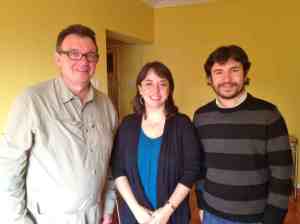
During our week in Mumbai we spent time with the team at International Justice Mission with Sanjay Macwan, the IJM Mumbai Director and Jamie McIntosh, part of the Arrow Leadership community and Executive Director of IJM in Canada.
It provided us an opportunity to meet with their team – a committed group of men and women who go out daily gathering information on brothels and human trafficking sites throughout Mumbai. It was a real eye opener for Bob and I to hear them tell of the detail that goes into finding girls and women who have been forced into the sex trade and partnering with local officials to release them.
Effective
The topic of human trafficking has been somewhat trendy in North America among Christian organizations for the past five or more years. By that I mean that many organizations have started using the language in their brochures and newsletters – now how involved they are in effectively doing something about it is another question. IJM are effective.
Informed and knowledgeable as I was on the subject, I was not prepared for the emotions related to being in this setting with this team and then meeting some of the girls freed from slavery by the cooperative work of IJM and the law enforcement agencies of Mumbai.
Carson gets Angry
A large percentage of adult women and men in prostitution here are trafficked into “the trade” by force, fraud or coercion. Typically, the victims are young women and children from villages who are recruited by traffickers through the fraudulent promise of work in the cities. When they arrive – usually by India’s efficient trains – they are sold to brothel owners and forced into prostitution in any number of different venues, from the more traditional “cages” brothels to beer bars, dance clubs, slum brothels, and flat brothels scattered across this massive city.
There are naive and vulnerable girls lured by slick-talking people promising them work who are then often drugged, beaten while they are held hostage for sex. These are children, and the casualties of human trafficking that IJM are specifically targeting. While visiting the girls in one Aftercare home we saw a room filled with sewing machines with girls producing beautiful products. It was encouraging to see the smiles on their faces as you admired their work.
“Every one of these girls has been raped,” the Aftercare home director said quietly.
My head tilted to the side.
I felt numb.

But then anger began to well up inside me. I was ready to call the Pue boys, get them over here and help me do something about this. I will not share what I was thinking of doing – but I was so upset by how ‘not right’ this all was. My favorite Bible verse suddenly become Matthew 21:12 (I am saying that with a smile).
Extreme Poverty Ripples Out
In places of extreme poverty mothers also sell their children into prostitution for a quick but meager influx of cash. We met a young girl in an IJM Aftercare home who had been sold by her mother for only eight thousand rupees, about $150 Canadian dollars. These girls are locked up for days, starved, and beaten until they learn to service up to 25-30 clients a day.
As I stared at this sweet dear child in front of me I pictured my grandsons who are excitedly awaiting my arrival back home. I thought of Kristin and Shari, my two daughters-in-law who are amazing mothers and love their boys so much. I wondered how possibly a mother could sell their own child and just walk away. It is beyond our ability to even imagine –but extreme poverty has ripple effects that are often out of sight and out of mind.
Minor victims
 Unfortunately, sex trafficking is thriving in Mumbai and this was completely visible to us. I personally saw young girls that were unquestionably minors who were now working in the red light district. While I expect that it is near impossible for anyone to get accurate statistics the country’s federal police said four years ago that 1.2 million children were involved in prostitution in India. IJM have noticed a decrease in minors in the years following but I suspect that it is because of the work they and others are doing with local law enforcement to focus specifically on seeking convictions for those who are trafficking children.
In our week there we celebrated with the team on the ruling from the courts convicting a brothel manager from an arrest they assisted with two years earlier. There are many stories of rescues that provide hope and I am so impressed by the passion, conviction and professionalism of the International Justice Mission staff. They don’t want a “Pue boy” solution like I had in my head. This team of Indian nationals wants to actually change the system, the society, so that this will stop completely.
To act justly
As a follower of Jesus of Nazareth, and a leader in the church, I am inspired by Michah 6:8 and the mandate that it shouts out for Christians:
He has showed you, O man, what is good.
And what does the LORD require of you?
To act justly and to love mercy and to walk humbly with your God.
Walking humbly with God means taking a healthy assessment of who you are – recognizing that it is only by Jesus and God’s grace that you are saved from your sinful nature. Others can as well and need to be told of this.
Loving mercy is to be compassionate for our God is a compassionate God. We are to have mercy on those impoverished around us. I believe every Christian needs to have some aspect of their life and income focused on people in poverty. Consider how you can reflect God’s heart for the poor, the disenfranchised, the marginalized, the strangers and aliens, the migrants and refugees, the hopeless and helpless, and the last, the lost and children.
To act justly is to do what is right – re-enacting God’s mercy. Our serving justice in an unjust world is our acting out the gospel. But to act justly is much more difficult for churches, for by doing so we seek to address underlying causes more than symptoms. Although difficult, it must be a part of Christian ministry. I am personally challenged to help see that justice is a part of being a fully mature disciple in our community and can hardly wait to gather our Mission and Justice team at First Baptist to discuss these things with them.
Howard Snyder summarized the challenge for those of us leading in the church: “Kingdom people seek first the Kingdom of God and its justice; church people often put church work above concerns of justice, mercy and truth. Church people think about how to get people into the church; Kingdom people think about how to get the church into the world. Church people worry that the world might change the church; Kingdom people work to see the church change the world”
Back Home
When I am home in Vancouver, in a North American context this will take on a different ‘feel’ than it does for me right now being a fresh experience. I have a video I am bringing home and will show when speaking if appropriate. It is about a young girl that we were with at the Aftercare home. When Jamie asked how she was doing she looked at him with eyes that were hopeful but did reveal she has lived in hell for part of her childhood.
With a strong voice and a smile on her face she said, “I no longer look back at the past, I have been rescued and I am looking forward. I want to live in such a way that other girls will not have to go through what happened to me.”
This young woman was rescued and will never be the same.
After meeting her, I don’t think I will be either.



 From My Chair