When a Leader is Falsely Accused

Have you ever had the experience of someone deliberately attacking your character and trying to ruin your reputation by unjustly accusing you?

Dave Toycen, president of World Vision Canada, has been plagued by a malicious and erroneous email that has ‘gone viral’ stating he is overpaid, drives an expensive car, and lives in an extravagant house.

I am close to Dave and respect him deeply as a leader. With grace and skill, he leads a complex organization that everyday is making a difference in the lives of vulnerable children, families and villages around the world. We travel together; hang out together – why I have even seen him get into his car!

For the past seven years I have served on the board of directors for World Vision Canada and as such am one of those responsible for setting Dave’s salary and benefits. In a spirit of authenticity and transparency our board has been posting his salary on the website for years along with our policy on executive compensation.

http://www.worldvision.ca/About-Us/financial-information/Pages/our-approach-to-executive-compensation.aspx

These false accusations quickly circle the globe on the world-wide web and land in the inbox of people who may be monthly supporters of World Vision’s work with children. The result? Some supporters call the World Vision Office and express deep concern. This uses valuable staff time as they respond. Others withdraw their support without even checking to see that the email is identified as an “urban myth” as the public site www.snopes.com clarifies.

The ripple effect of this attack on one leader is that boys or girls suffer. They are the ones ultimately impacted by an erroneous email filled with misinformation. Children, who every day are simply trying to survive due to the effects of poverty, are hurt by someone trying to find fault, blaming and condemning.

So what can you do?

If we receive emails making claims that are harsh and judgmental we must not circulate them without verifying facts. The internet becomes a contagion for spreading lies. Remember people at the other end of that email are impacted by this – in this World Vision case, poor innocent children.

But what if you are the one who is being falsely accused? Most Christian leaders I know or mentor experience the challenge of a false accusation at some point in their life of leadership.

False accusations and unjustified attacks eat leaders up from the inside. Afflicting you, discouraging you, and distracting you from the people or mission to whom God has called you; a lie is intended to destroy you. It is a natural response to want to strike back, to fight the lies, and stop the attack. However, in my experience, this is very difficult to do and seldom accomplishes what we desire. I mentor leaders to not perpetuate a feud that could go on for years but rather ‘let it go’.

What God desires is that we leave it with Him. If someone is attacking a Christian leader then God is also being attacked and He teaches: “Dear friends, never take revenge. Leave that to the righteous anger of God. For the Scriptures say, “I will take revenge; I will pay them back,” says the LORD. (Romans 12:19 NLT).

God can defend His own name and in doing so vindicate those falsely accused. Our problem is often waiting for God to act.

So let’s not stand for any more false accusations. Pick up the phone and check it out before you are tempted to forward a malicious email.

What saddens me the most is that I strongly suspect the source for the email I have been referencing was one who would claim to be a Christ follower.

Romans 14:10 in the Amplified Bible reads, “Why do you criticize and pass judgment on your brother or sister? Or you, why do you look down upon or despise your brother or sister? For we shall all stand before the judgment seat of God”.

It continues in verses 12-13:  (12) “And so each of us shall give an account of himself – give an answer in reference to judgment – to God.”  (13) “Then let us no more criticize and blame and pass judgment on one another, but rather decide and endeavor never to put a stumbling block or an obstacle or a hindrance in the way of a brother or sister.”

Nitro Leadership

How fast can a leader walk 60 feet?

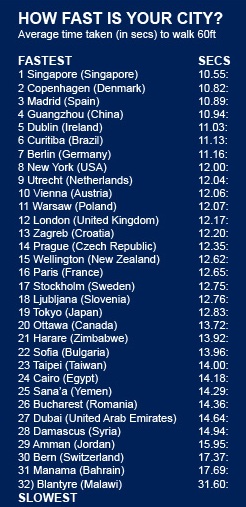
Professor Richard Wiseman has spent his life investigating studies mainstream research scientists avoid. For example he was poking around the observation that the pace of life is much quicker today than it was in the past. So he decided to measure the average time taken to walk 60 feet in major cities around the world. He was inspired by a study carried out in the early 1990s that showed our walking speed to be a reliable measure of the pace of life in a city, and that people in fast-moving cities are less likely to help others and have higher rates of coronary heart disease.

His findings of the fastest cities included Singapore in the number one spot, seven ahead of New York #8. I was surprised in some ways to see Dublin in the #5 position. Canada’s capital city Ottawa was #20 and the majority of the bottom ten were cities in the Middle East.

How fast do you walk 60 feet?

  • Are you a fast person in a slow city?
  • Are you a slow person amidst a fast paced culture?
  • Are you a fast leader in a slow organizational culture?
  • Or a slow leader in an organization going at light speed?
You can take Dr. Wiseman’s quiz here.

The majority of highly positioned Christian leaders are functioning like they are injecting nitro and it is taking it’s toll. (Oh wait, that’s coffee.)

Undeniably the pace of life is increasing in North America among Christian leaders. Why? Here is my list:

    1. Sadly there is competition among the parachurch ministries, and churches, leading to some serious, driven, work environments.
    2. Lack of resources have led many leaders to lay off staff and forced them to do much more with less.
    3. We have stopped caring for those we work with or who work for us. If congregations really cared about their pastors they would come alongside as loving brothers and sisters to solve the issues behind overtaxing expectations. I say this realizing that some of these issues are the pastor’s – others belong solely with the church.
    4. Underneath each ministry there is an unspoken, powerful question about relevance that makes leaders secretly uneasy and propels them into frenetic lifestyles as they pursue the next fad.
    5. We expect too much. Most leaders set such high standards for themselves they cannot even reach them – usually well beyond what those they serve actually expect.

Leaders should be concerned about the impact of a fast paced life. I admit, I like the rush of the city and the in and out travel schedule – but I have learned, it does take a toll.

The incidence of medical problems is on the rise among Christian leaders. The continuous struggle to meet deadlines, the need to continuously update themselves about the latest changes in their ‘field’ and the swiftness required to accomplish a task makes leaders stressed. The stress in turn lowers our immunity and makes us vulnerable to a large number of health problems. These can be simple skin problems such as a rash or other complicated medical problems such as hypertension, diabetes, heart problems and even nervous breakdown.

The fast pace of life causes a large number of family problems. Leaders are so busy in fulfilling their job requirements that they have very little time to spend with family. As a result the family structure is being shattered. Those who are married are getting divorced while those who are single have no time for meaningful relationships that might lead to the love. Leaders who are parents are prone to ignoring their children and as a result children are becoming distant from their parents and have little affiliation with their faith beliefs or interests.

Having just returned from my “selah,” – an intentional pause from a pretty hectic schedule – I realize how many leaders, like myself, need to slow down. The problems of the face paced life out weigh the meager benefits.

Lunched with John McAuley today and he spoke of Psalm 23:2 “He makes me lie down in green pastures.” If we as leaders don’t do something about our pace – God may cause us to lie down. Both John and I have experienced this.

So what should our response be? Without over simplifying, we are to turn to Jesus. Christian leaders need to remember that Jesus promised us “rest” if we come to Him – not an endless list of expectations. For each of my five reasons above – leaders can be mentored and learn how to truly lead through challenges but it is highly personalized for each man and woman.

Work hard by all means, but make sure the pace is sustainable.